Most people picture a house deed as a fancy certificate, like the title to a car. A real deed is plainer than that: a typed legal form that's signed, notarized and recorded with the county1,2.
Here's a labeled example, what each part means and how to see the deed on file for your own home.
What does a deed look like?
A house deed looks like a typed form on plain paper, with a blank space at the top for the county's recording stamp. The sample below is made up, but it follows the layout of a California grant deed. Los Angeles County's consumer affairs office numbers the same parts on its own sample grant deed1.
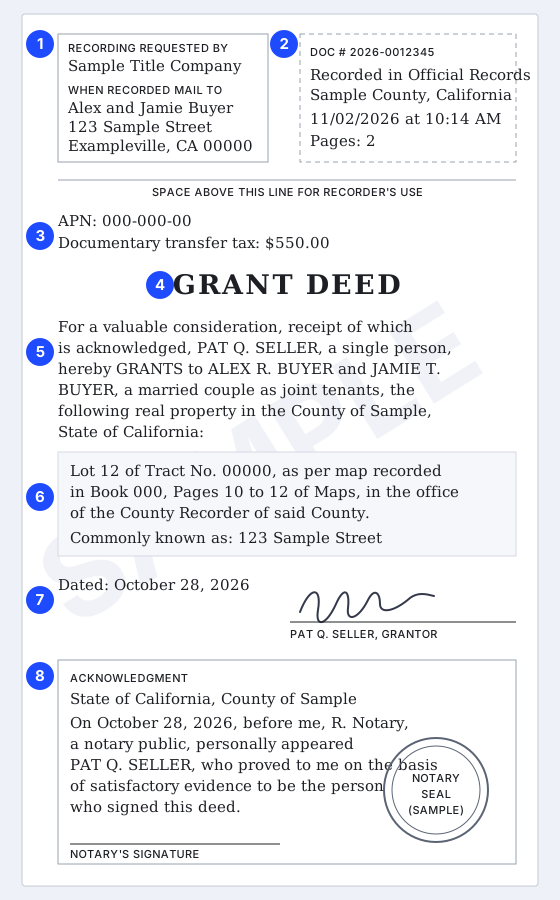
Your own deed may look different. The exact form depends on the type of deed and on your state and county. Still, most deeds carry the same basic information3.
What does each part of a deed mean?
Each number on the sample matches a part below, from the top of the page down.
- Recording requested by, and mail to. The top-left box names who asked the county to record the deed, usually whoever prepared it. It also gives the address where the county mails the deed after recording1.
- The recorder's stamp. The county stamps the top-right space when it records the deed and lists the document number there1. Recording details can also include a date or a book and page number3.
- The parcel number and transfer tax. The assessor's parcel number (APN) is the number the county assessor gives your property. The transfer tax line shows any tax paid on the sale, which varies by location1.
- The title of the document. The heading names the type of deed, such as a grant deed, warranty deed or quitclaim deed. Each type makes different promises about the title, as our guide to the main types of deeds explains.
- The grantor, the granting words and the grantee. The grantor is the owner giving the property, and the grantee is the person receiving it. Words like "grants to" show the grantor means to hand it over1.
- The legal description. This is the official description of the land, often by lot and tract. It's more exact than a street address and should lay out the property's boundaries1,2.
- The date and the grantor's signature. A deed is usually dated when the grantor signs it. The grantee doesn't have to sign1.
- The notary's acknowledgment and seal. A notary public confirms the identity of the person signing and adds a seal. This part also names the county and state where the deed was signed1.
The "valuable consideration" line is about the price. It doesn't have to list the full amount. TexasLawHelp says Texas deeds often read "$10.00 and other valuable consideration," even though homes sell for far more2.
You may also see an order or escrow number. Title and escrow companies use it to track their own files1. To check the names, dates and stamp on your own deed, use our five-point deed check.
Do all deeds look the same?
No, and some papers that look like deeds aren't deeds at all.
A deed of trust has "deed" in its name, but it's a loan document. It puts the home up as security for a loan, much like a mortgage2. Here's how to tell the papers apart:
| Document | What it does | How to spot it |
|---|---|---|
| Deed | Passes ownership from the grantor to the grantee | Names both and uses words like "grants to" |
| Deed of trust or mortgage | Ties a loan to the home as security | Names a lender, and a deed of trust also names a trustee |
| Reconveyance or release | Shows a loan was paid off | Recorded after a payoff; one recorder calls it "not a title document" |
| Property tax bill | Bills the owner for the year's taxes | Comes from the tax office and shows the parcel number but passes nothing |
Sources: TexasLawHelp, Los Angeles County Department of Consumer and Business Affairs and San Joaquin County Assessor-Recorder-County Clerk1,2,4
Paying off a loan doesn't change your deed. The county records a release or reconveyance instead, and your deed from the purchase stays the same5. Here's what happens once you pay off your mortgage.
What does the title of a house look like?
Usually, there's no title paper for a house. A car comes with a title certificate, but a home's title is the ownership itself. TexasLawHelp puts it this way:
Real estate title is not a document. Rather, it is the strength of one's ownership claim.
Your recorded deed, and the deeds before it, are the proof. TexasLawHelp calls deeds the links in the chain of ownership2. Our guide to deed vs title explains the difference in full.
How can you see the deed on file for your home for free?
Search your county's land records online, or view them in person. San Diego County, for example, lets anyone view recorded documents free on public kiosks in its offices. Copies cost a fee6.
- Find the office that records deeds. It may be called the county recorder, the county clerk or the register of deeds3.
- Search by your name or your parcel number. Your parcel number is printed on your property tax bill6.
- Open the latest deed for your home. Your name should appear as the grantee, with the county's recording stamp at the top.
- Look at anything recorded after it. A deed or loan you never signed is a reason to act the same day. Our guide to finding your deed covers the search in detail.
- Order a certified copy if you need one for legal use. San Joaquin County's recorder says original documents are generally not accepted for legal purposes4.
A forged deed can look like the real thing. The FBI's June 2026 warning about vacant land scams describes a made-up deed that helped convince agents a fake seller was real7. So the county record matters more than the paper in your drawer.
Let the county tell you about new filings. Many counties send a free email when a document is recorded in your name. See which counties offer a free alert and sign up for the one where your home is.
For every other free step, start with our guide to protecting your home title for free.
Links on this page were checked on November 16, 2026.
Frequently asked questions about house deeds
When you buy a house, do you get a copy of the deed?
Is the title and the deed the same thing?
No. TexasLawHelp says "Title is the property right. The deed conveys that right."2 The deed is the paper, and title is the ownership it passes on.
Who holds the deed to your home?
You usually keep the original, and the county keeps the official record. For legal use, get a certified copy from the county, since one recorder says originals are generally not accepted4. Losing the original doesn't change who owns the home.
Does a deed change when you take out or pay off a mortgage?
No. A loan is recorded as its own document, and paying it off adds a release. Sonoma County's recorder notes that the original deed isn't altered and no new deed is made at payoff5.
Pull up the deed on file for your home
Search your county's records by your name or parcel number. Then make sure the latest deed still names you.
Find your deed onlineSources
- Understanding Real Estate Documents: Grant Deed, Los Angeles County Department of Consumer and Business Affairs, checked November 16, 2026
- Property Deed Basics, TexasLawHelp (Texas Legal Services Center), last edited October 22, 2025
- House Deeds: What They Are & How to Get One, LegalShield, August 5, 2026
- Recorder FAQs, San Joaquin County Assessor-Recorder-County Clerk, checked November 16, 2026
- Paid Off Deeds, Sonoma County Clerk-Recorder, checked November 16, 2026
- Owner Alert, San Diego County Assessor/Recorder/County Clerk, checked November 16, 2026
- Protect Your Property from Illegal Sales Through Parcel Owner Impersonation, FBI Internet Crime Complaint Center, June 16, 2026