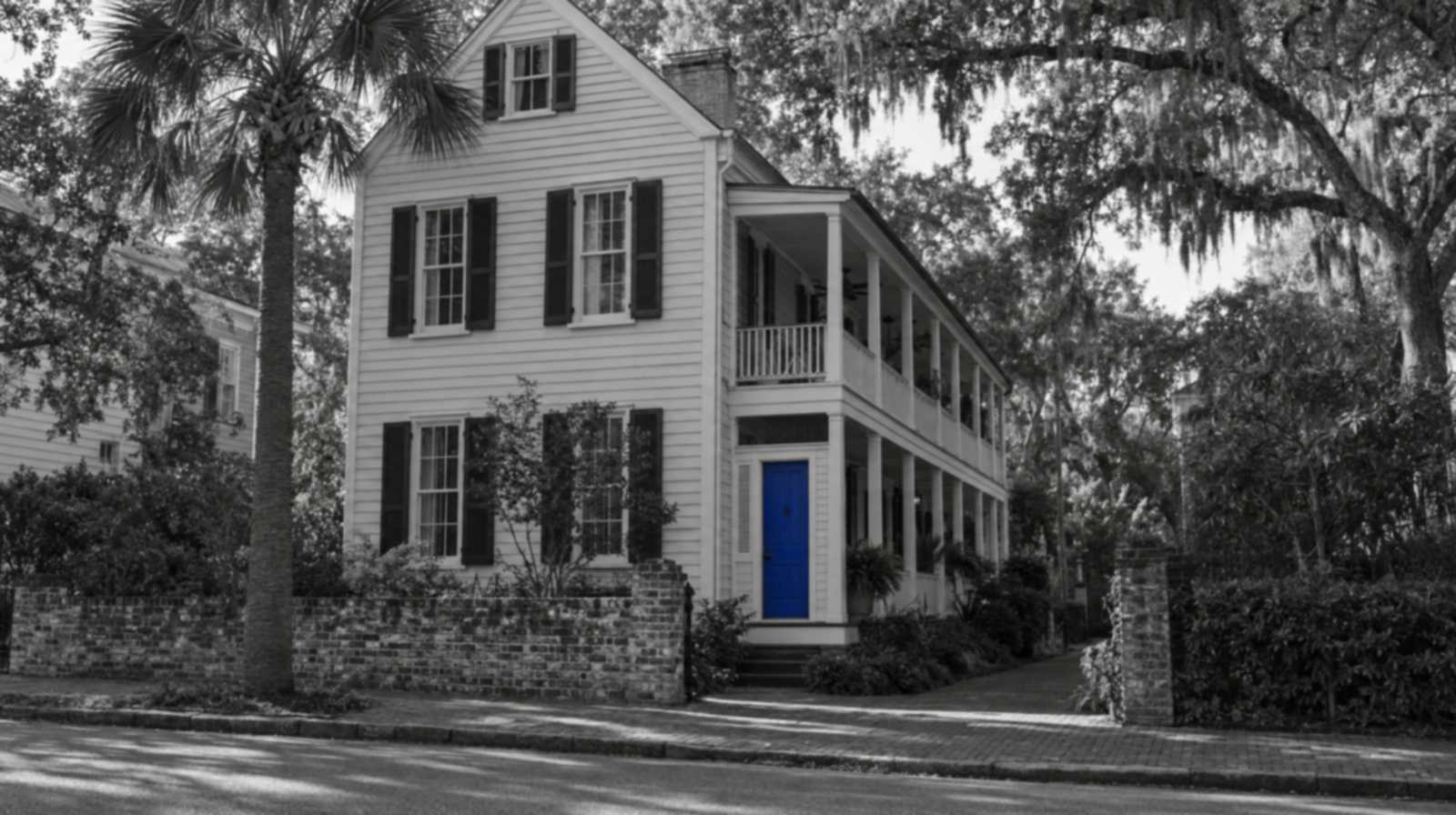
George Singleton acquired 8 acres in Awendaw in 1892 and never wrote a will. By 2018, a judge had counted 44 owners of that land, and his great-great-granddaughter Evelyn Brown held just over half of a 1 percent share1.
A Charleston County deed search is where families like hers start. It is free, and it shows whose name is still on the land. Here is how to run it, why land held this way slips away, and where to get free legal help.
Why does so much Charleston County land sit in a dead owner's name?
Many families who bought land after the Civil War passed it down without wills or probate. Each generation added owners, but no one recorded a new deed1.
South Carolina law calls this heirs' property. It means land inherited from a relative and owned as tenants in common, with no probate or recorded deed giving today's owners clear title2.
By the 1890s, the South Carolina Land Commission, set up to help freed people buy land, had sold more than 44,500 acres to African-Americans. Settlements from that era, such as Phillips, Snowden, Scanlonville, Six Mile and Ten Mile, are now ringed by new subdivisions1.
"I live in Snowden and we still have properties in dead peoples' names and people living on (the properties)."
Statewide, the known numbers are small. The Federal Reserve Bank of Richmond counts known heirs' property at 0.2 percent of South Carolina parcels and calls that "a low-end estimate"3.
- Deed
- The paper that moves land to a new owner. It also names earlier owners4.
- Tenants in common
- Co-owners who each hold a share of the whole parcel.
- Probate
- The court process that settles a dead person's estate.
- Partition
- A court case that divides co-owned land or orders it sold.
How do you do a Charleston County deed search?
Find the deed's book and page, search the Register of Deeds by name and date, open the image, then work backward. Charleston County's recorder of deeds is called the Register of Deeds, and you can do most of this online for free.
- Find the book and page. Look up the address on the county's GIS map or the Auditor's tax site. Both show the deed's book and page, the Register says5. If you don't know the owner, the Assessor's office can match the parcel to a name6.
- Search by name and date. In the Register's document search, choose Deed, type a seller's or buyer's last and first name, and pick a date range on the calendar5,6.
- Open the deed. Double-click a result to open the image as a PDF you can print or save. Downloads are free, and counter copies cost 50 cents a page5,6.
- Work backward. Each deed names earlier owners, which tells you whose name to search next4. Book numbers start with a letter and three digits, like A3006.
- Go back before 1978. The online index starts in 19784. For older land, the Archive Search opens record books from 1719 to 1960 by book and page, with more added as staff restore them7.
- Check the probate trail. The Index Books menu lists "Probate Cross Heir" and "Probate Deceased"8, and the Register's home page links to an online estate and wills search4.
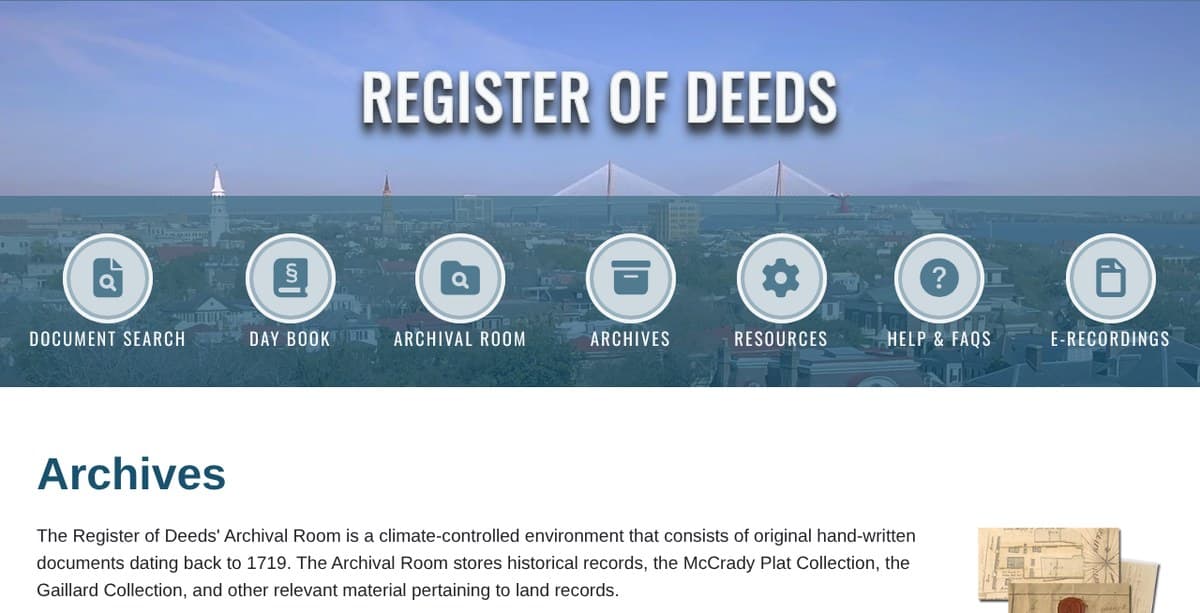
The office itself is at 101 Meeting Street, Suite 200, in downtown Charleston, (843) 958-4800, open weekdays from 8:30 AM to 5 PM4. If the house is already in your own name, our guide to finding the deed to your house is a quicker read.
Which Charleston County property records cover which years?
The online index starts in 1978, deed images in October 1994, and the old record books in 1719. Each sits in a different corner of the county's website.
| Record | Years | Where to look | What you need |
|---|---|---|---|
| Parcel and deed book and page | Today | County GIS map or Auditor's site | A street address |
| Deed and mortgage index | 1978 to today | Register's document search | A name and a rough date |
| Deed images | October 1994 to today | Click a result in that search | Nothing more |
| Old record books | 1719 to 1960, going online | Archive Search | Book and page |
| Papers recorded today | New recordings only, since November 3, 2025 | Day Book | A date and time |
Sources: Charleston County Register of Deeds pages 4, 5, 7 and 8, read October 25, 2026.
Can the county's free recording alert watch family land?
Partly. The Register's free Property Recording Alert emails you when a new filing matches a name you register. It follows names, not land.
Sign up at recordingalert.charlestoncounty.gov with a last name, a first name and an email address, then confirm the county's email9. It matches the first three letters of each name, so "Ann Joh" also catches Annette Johns9. The Register launched it in August 202510.
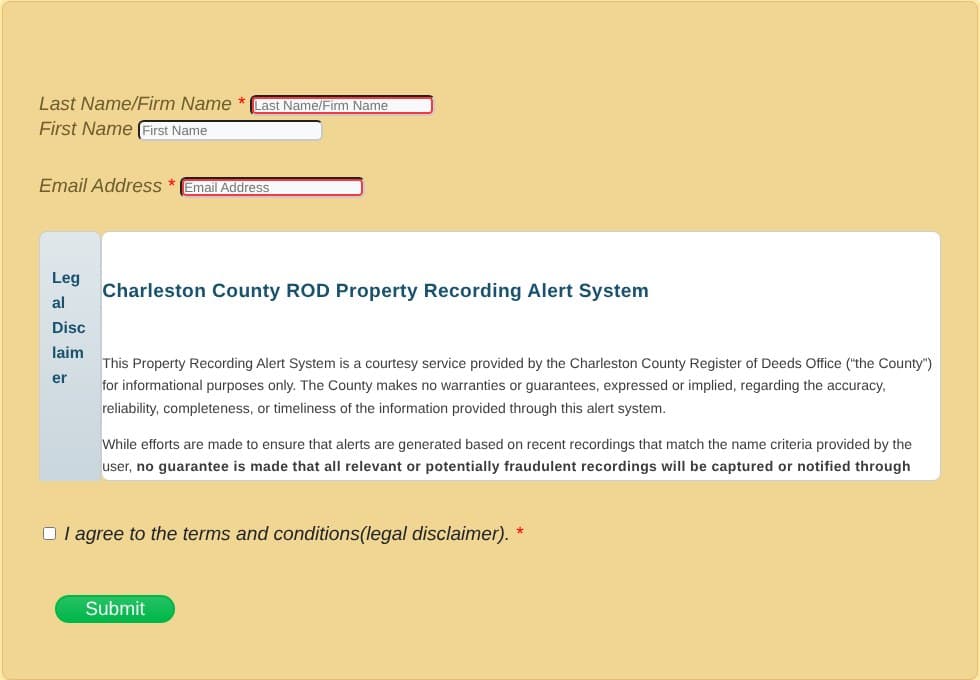
What it does
For family land, register each heir, and think about adding the name still on the old deed. The county says the alert is not an official record and does not replace a title search11. Our state-by-state map of county alerts shows which other counties offer one.
Why is heirs' property so easy to lose?
One heir can push for a court sale, and unpaid taxes can end in a tax sale. Road money can also sit in court when no one can prove who owns the land.
Many such properties have been lost "through tax sales or partition sales." A partition sale starts when one heir wants their share and forces a sale12. In 2018, Josh Walden, then legal services director at the Center for Heirs' Property, said heirs' property is "only as safe as the person who values it the least"1.
One purchase in the 1800s, dozens of co-owners later
Co-owners of three Charleston County family tracts, as reported
Show the numbers
| Bennett land, Phillips (bought 1880s) | about 30 |
|---|---|
| Singleton land, Ten Mile (bought 1892) | 44 |
| Bryan land, East Cooper (bought 1875) | 144 |
Source: The Post and Courier, December 5, 2018 1 (44 owners, from a judge's ruling) and September 4, 2020 13 (about 30 partial owners; 144 descendants who sold in 2019).
Since 2017, the Clementa C. Pinckney Uniform Partition of Heirs' Property Act has given heirs more say in court14. A judge must set the land's value and let other heirs buy out anyone who wants a sale.
The court also divides the land when it can, and a sale normally goes through a licensed broker on the open market14.
Taxes come next. Charleston County real estate taxes are due by January 15, and after March 17 the bill carries a 15 percent penalty and goes to the Delinquent Tax Department15.
Road projects can cost heirs, too. In 2020, one county plan to widen Highway 41 called for buying land from 84 properties, 71 of them in Phillips. When owners are unclear, the government "deposits the payment in court," and heirs must clear title to collect13.
Where can families get free heirs' property help in Charleston?
The Center for Heirs' Property in North Charleston offers anyone a free one-hour consultation with a lawyer. Families who qualify pay no attorney fees16.
A free hour with a lawyer
Call (843) 745-7055. The office is at 8570 Rivers Avenue, Suite 170, North Charleston, and intake can be in person, by Zoom or by phone16.
Free attorney work on the title
You must want to keep the land, meet federal income guidelines, build an accurate family tree and own heirs' property in a county the Center serves, such as Charleston. The whole family must agree, and the Center does not handle sales16.
Clearing title no longer has to raise the tax bill. Under the 2026 Heirs' Property Tax Relief Act, a family deed that clears heirs' property does not trigger a reassessment. The family members involved must give the county assessor sworn statements2.
The Charleston County Assessor is at 4050 Bridge View Drive, Suite 100, North Charleston, (843) 958-41007.
We checked every link, phone number and clinic date on this page on October 25, 2026.
What happened to heirs' property families in Charleston County?
Court records and news reports show a claim that came too late, a tract split among dozens of owners, and a family that cleared its title.
No one in these stories was charged with a crime. Forged deeds are a separate problem, covered in our plain guide to deed theft.
Frequently asked questions
Are deeds public record in SC?
How to get heir property in your name in SC?
Do all heirs have to agree to sell property in South Carolina?
Who pays taxes on heirs' property?
What to do if you suspect deed fraud?
Get a copy of the document from the Register of Deeds and call a lawyer right away, as the county's alert FAQ advises9. Forging a land record is a crime in South Carolina, so report it to the police21. A quiet title action is the court case that clears a false deed.
Look up the name on your family's land
Search that name in the Register's records, save the deeds you find, and sign each heir up for the free county alert.
Open the Register's deed searchJoin the free recording alertSources
- SC land slipping away from families amid fragile claims and explosive growth, David Slade and Angie Jackson, The Post and Courier, December 5, 2018.
- Act No. 149 of 2026 (H.4477), the Heirs' Property Tax Relief Act, South Carolina General Assembly, signed May 15, 2026.
- Land at Risk: Heirs' Property in the Carolinas, Federal Reserve Bank of Richmond, December 19, 2024.
- Register of Deeds home page (hours, data dates, history, common terms), Charleston County, read October 25, 2026.
- Register of Deeds document search (Name/Date help text), Charleston County, read October 25, 2026.
- Register of Deeds Help and FAQs, Charleston County, read October 25, 2026.
- Register of Deeds Archive Search, with the county office directory and legal disclaimer, Charleston County, read October 25, 2026.
- Register of Deeds Day Book and search menu, Charleston County, read October 25, 2026.
- Property Recording Alert System: Frequently Asked Questions (PDF), Charleston County Register of Deeds, read October 25, 2026.
- Register of Deeds new alerting system (news release, PDF), Charleston County, August 11, 2025.
- Property Recording Alert System sign-up page and legal disclaimer, Charleston County Register of Deeds, read October 25, 2026.
- Heirs' property owners now protected from some surprise tax bills under new South Carolina law, David Slade, The Post and Courier, July 12, 2026.
- Widening Highway 41 would take family land in Phillips, but owners could go unpaid, David Slade, The Post and Courier, September 4, 2020.
- S.C. Code Title 15, Chapter 61: Partition, including the Clementa C. Pinckney Uniform Partition of Heirs' Property Act, South Carolina Legislature, read October 25, 2026.
- Treasurer's Office: tax due dates and penalties, Charleston County, read October 25, 2026.
- Legal services, Center for Heirs' Property, read October 25, 2026.
- Free Wills Clinic, November 21, 2026, Johns Island, Center for Heirs' Property, read October 25, 2026.
- Free Wills Clinic, December 12, 2026, Awendaw, Center for Heirs' Property, read October 25, 2026.
- Robinson v. Estate of Harris, Opinion No. 26914, South Carolina Supreme Court, January 24, 2011.
- S.C. Code Title 62, Chapter 3, Section 62-3-108 (ten-year limit on probate), South Carolina Legislature, read October 25, 2026.
- S.C. Code Title 16, Chapter 13, Section 16-13-10 (forgery), South Carolina Legislature, read October 25, 2026.