The Duval County Clerk's calendar lists 14 online tax deed auctions in 2026, the last on Wednesday, October 28. The next date it shows is January 13, 20271. If your home, or a late parent's home, could be headed for a Duval County tax deed sale, you have more ways to act than the auction site lets on.
Here is that process from the owner's side, step by step, with two Jacksonville cases.
How does a Duval County tax deed sale start?
It starts with one unpaid tax bill, and the auction comes at least two years later. Bills go out in November and are due by March 31. Anything unpaid is delinquent, or overdue, on April 12.
Next, on or before June 1, the Tax Collector sells a tax certificate on each unpaid bill2. Duval's 2026 certificate sale was set for May 27, online. Investors bid on the interest rate, and the lowest rate wins3.
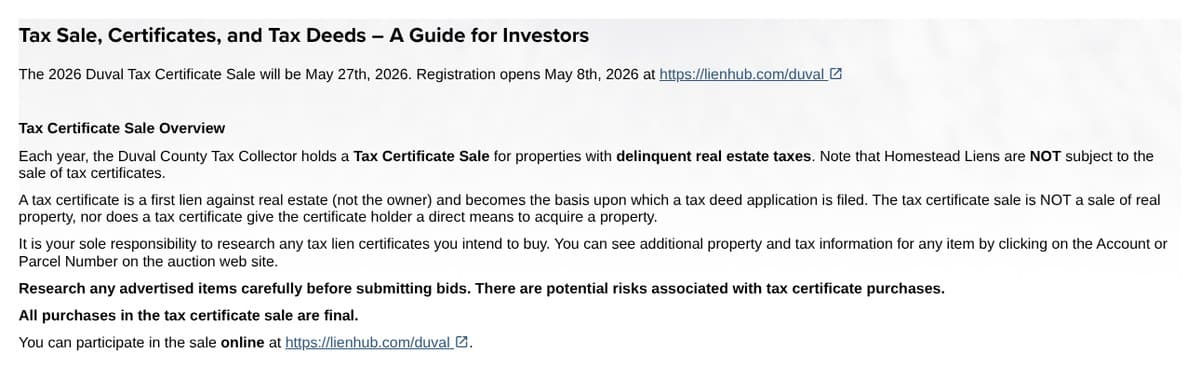
A certificate isn't a deed. The Tax Collector calls it "a first lien against real estate (not the owner)"3. A lien is a legal claim on property for money owed.
The holder can't contact you to demand payment until two years after April 1 of the year the certificate was issued4. After those two years, the holder can apply for a tax deed, and that sets up the auction5.
From a missed tax bill to a Duval tax deed auction
Your window to pay stays open until the winning bid is paid in full
Sources: Duval County Tax Collector2,3, Duval County Clerk6 and Florida Statutes 197.522, 197.472 and 197.5828,9,13, checked October 25, 2026.
- Tax deed
- A deed is the document that transfers ownership of a property. A tax deed transfers yours to the winning bidder at the Clerk's auction.
- Redeem
- To pay everything owed on the certificates. That ends the tax deed case.
- Surplus
- The part of the winning bid above the opening bid. Some liens get paid from it first.
- Homestead
- Your main home, if you have the homestead exemption from the Property Appraiser.
When are Jacksonville's tax deed auctions held?
Online, on Wednesdays at 9 a.m., once or twice a month from January through October. The Clerk's calendar lists 14 sales in 2026 and 16 in 20251. Bidding takes place on duval.realtaxdeed.com, where the Clerk posts each sale's property list 30 days ahead6.
Before a home can be sold, Florida law requires several warnings:
- A newspaper notice once a week for four weeks. In Duval it runs in the Financial News and Daily Record6,7. The sale can't take place until 30 days after the first notice7.
- A certified letter from the Clerk at least 20 days before the sale. It goes to the people on the Tax Collector's list8.
- A sheriff's notice to the owner of record at least 20 days before. If no one can be served, the sheriff posts it at the last known address8.
- A public record. The Clerk records a notice of the tax deed application in the Official Records, the county's public land records5.
There's a catch. The Clerk may rely on the Tax Collector's addresses and has no duty to dig further, because owners "are presumed to know that taxes are due"8.
A letter you never got doesn't, by itself, undo a sale8. So make sure the mailing address on your tax bill is one you actually check.
How do you check if your home is headed to auction?
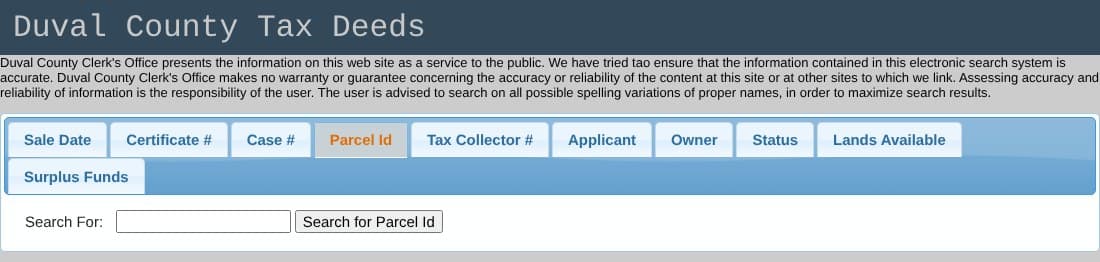
Search your parcel number on the Clerk's free tax deed site. If a case is open, the results show its sale date, status, opening bid and any surplus1.
- Find your parcel ID. It's the number the county uses for your lot. Look for it on your tax bill or the Property Appraiser's website.
- Open taxdeed.duvalclerk.com and pick the Parcel Id tab. Type the number and click "Search for Parcel Id"1.
- Read the status. The site's list includes Sale, Resched, Redeemed, Sold, Unsold and Lands Available1. It doesn't define them, so call the Tax Deed Department at (904) 255-1916 if yours isn't clear6.
- Get the payoff from the Tax Collector. The Clerk doesn't quote or take redemption payments. Call (904) 255-5700, option 4, or visit any Tax Collector branch6.
- Look at the case file. The Clerk's Tax Deeds page links to its public file search, which holds the case papers6.
Can you still stop the sale, and how?
Yes. Pay the Tax Collector in full before the Clerk receives the winning bidder's full payment. The Clerk's FAQ and Florida law set the same cutoff6,9.
To redeem, the FAQ says, an owner or mortgage holder pays the overdue taxes "and all costs associated with the process"6. That cutoff comes fast. Winning bidders must pay in full by 4 p.m. the next business day6.
After that, Florida law lists only a few grounds for undoing a tax sale, such as proof the home was redeemed in time10. Courts have also voided sales over faulty notice, as the Delta case below shows. The Clerk's FAQ says a former owner can take the sale to court, where "the judge will decide"6.
If the home has a homestead exemption, the opening bid adds half of its assessed value5,6. That raises the price a bidder must pay, and the added amount is handled as surplus13.
To stay current next year, the Tax Collector's installment plan spreads the bill over four payments12.
| Office | Call them for | Contact |
|---|---|---|
| Tax Collector, Tax Department | The payoff amount and the redemption payment | (904) 255-5700, option 4 |
| Clerk, Tax Deed Department | Sale dates, case files and surplus claims | (904) 255-1916, Room 1054, 501 W. Adams St. |
| Jacksonville Area Legal Aid | Free legal help, if you qualify | (904) 356-8371 |
| Jacksonville Sheriff's Office | A deed or lease you think is fake | (904) 630-0500 |
Table sources: Duval County Tax Collector3, Duval County Clerk6,14,18 and City of Jacksonville17.
Sale dates, phone numbers and links in this guide were checked on October 25, 2026.

Who gets the money if your home sells for more than the taxes?
The extra pays government liens first, then other valid liens, and then the former owner. You have to file a claim to get it.
The Clerk mails a Notice of Surplus Funds to the people entitled to notice, and claims are due within 120 days13. In the words of the Clerk's form, "The Clerk must pay all valid liens before distributing surplus funds to a titleholder / owner"14.
Source: Duval County Clerk, Claim to Receive Surplus Funds, form updated August 4, 2026
Here is what a claim needs, from the Clerk's surplus claim form14:
- The form itself, complete and signed in front of a notary.
- A copy of your photo ID, such as a state ID.
- Proof of your right to the money, such as probate records (papers from the court case that settles an estate), your recorded deed, a lien or a mortgage. Attach a copy of the Notice of Surplus Funds too.
- The original, delivered in person or by mail to the Tax Deeds Department, Room 1054, 501 West Adams Street.
Questions go to Ask.Taxdeeds@DuvalClerk.com or (904) 255-191614.
If no one files a claim within 120 days, Florida law presumes the owner of record is entitled. The Clerk then handles the money under the state's unclaimed property law13. You can search for it at claimyourcashfl.gov, where the state says "there is never a fee to search for or claim your property"15.
What if the house is still in a late parent's name?
Then the tax notices, the surplus and the title all point to someone who has died, and each step gets harder. Notices go to the owner of record at the addresses the Tax Collector has8. A surplus claim needs papers that prove your right to the money, such as probate records14.
The City of Jacksonville calls this heirs' property, or a "tangled title": the public records don't clearly show everyone who owns the home. It funds help through Jacksonville Area Legal Aid and LISC Jacksonville for residents who qualify17.
Apply on the City's heirs' property page, or call JALA at (904) 356-8371, ext. 401, or LISC at (904) 351-0008. Applying doesn't guarantee help17.
The Clerk's free Property Fraud Alert can watch the family name, too. It sends an email, text or call when a document with that name is recorded in Duval, and over 47,000 people and businesses have signed up18. Other Florida clerks run similar alerts, and our state-by-state map of county alerts compares them.
What have tax deed and fake deed cases in Duval looked like?
A Jacksonville tax deed reached the Florida Supreme Court over a returned letter, and fake deeds on an inherited building led to arrests in 2026. Fake deeds have been uncommon in Duval. In 2022, Property Appraiser Jerry Holland told News4JAX the county had seen very few property fraud cases19.
The lesson isn't that a sale is easy to undo. It took the state's highest court. Keep your mailing address current and open anything from the Clerk.
Florida gives owners a faster path in cases like this one. A quiet title suit is a court case that settles who owns a property. When the suit is over a fraudulent deed, the owner is entitled to a fast-track procedure, and the court must restore the owner's title20.
Our guide to a quiet title action covers the steps and costs. Fake quitclaims are one form of deed theft, and if you find one on family property, start with the first steps after a fraudulent deed.
Frequently asked questions
Where can I find information about tax deed auctions in Jacksonville, Florida?
Start with the Duval Clerk's Tax Deeds page and the auction site, duval.realtaxdeed.com, where each sale's list goes up 30 days ahead. The Clerk's search at taxdeed.duvalclerk.com shows cases by sale date, parcel, owner or status. Sales are also advertised in the Financial News and Daily Record.
Where can I find the Duval County excess funds list?
Use the Surplus Funds tab on the Clerk's tax deed search, taxdeed.duvalclerk.com. If you may be owed money, the Clerk also mails a Notice of Surplus Funds to the addresses on file. Money no one claims is handled under Florida's unclaimed property law, so also search claimyourcashfl.gov.
Can I lose my house if I don't pay taxes?
Yes, but it takes years: in Duval, unpaid taxes first lead to a tax certificate sale by June 1. The holder must then wait two years from April 1 of that year to apply for a tax deed. You can end the case by paying the Tax Collector in full any time before the Clerk receives the winning bid in full.
Can you make payments on delinquent property taxes in Florida?
Not through Duval's partial payment plan, which covers current-year taxes only, from November 1 to March 31. To redeem a certificate, you pay the full amount owed. To avoid falling behind next year, apply by April 30 for the Tax Collector's four-payment installment plan.
What is the last day to pay property taxes in Florida?
March 31 for the bill mailed the November before, and payments in March get no discount. Taxes unpaid on April 1 are delinquent, and Duval adds at least 3% interest plus costs. Paying in November earns a 4% discount.
Look up your parcel before the next sale
The Clerk's tax deed search is free and needs no account. If your parcel shows a case, call the Tax Collector at (904) 255-5700, option 4, for the amount to redeem.
Open the Clerk's tax deed searchSources
- Duval County Tax Deeds (search, sale calendar and surplus funds tab), Duval County Clerk of Courts, checked October 25, 2026
- Real Estate (Property) Taxes, Duval County Tax Collector, checked October 25, 2026
- Tax Sale, Certificates, and Tax Deeds: A Guide for Investors, Duval County Tax Collector, checked October 25, 2026
- Section 197.432, Florida Statutes: Sale of tax certificates for unpaid taxes, Florida Legislature, 2026
- Section 197.502, Florida Statutes: Application for obtaining tax deed, Florida Legislature, 2026
- Tax Deeds (sale rules, redemption and FAQ), Duval County Clerk of Courts, checked October 25, 2026
- Section 197.512, Florida Statutes: Notice, form of publication, Florida Legislature, 2026
- Section 197.522, Florida Statutes: Notice to owner when application for tax deed is made, Florida Legislature, 2026
- Section 197.472, Florida Statutes: Redemption of tax certificates, Florida Legislature, 2026
- Section 197.122, Florida Statutes: Lien of taxes, Florida Legislature, 2026
- Partial Payments for Property Taxes, Duval County Tax Collector, checked October 25, 2026
- Installment Payment Plan, Duval County Tax Collector, checked October 25, 2026
- Section 197.582, Florida Statutes: Disbursement of proceeds of sale, Florida Legislature, 2026
- Claim to Receive Surplus Funds (information sheet and claim form), Duval County Clerk of Courts, form updated August 4, 2026
- Claim Your Cash: Florida unclaimed property, Florida Department of Financial Services, checked October 25, 2026
- Man Arrested for Using Stolen IDs in Elaborate Tax Deed Scam, Office of the Florida Attorney General, February 13, 2019
- Heirs' Property Assistance, City of Jacksonville, checked October 25, 2026
- Property Fraud Alert, Duval County Clerk of Courts, checked October 25, 2026
- Free Property Fraud Alert system launched in Duval County, News4JAX, June 21, 2022
- Section 65.091, Florida Statutes: Quieting title; fraudulent conveyances, Florida Legislature, 2026