If you searched for the Honolulu Bureau of Conveyances, you were looking for a State of Hawaii office, not a City one. It records deeds for Oahu and every other island from the Kalanimoku Building at 1151 Punchbowl Street1. Hawaii is "one of two states in the nation with a single statewide recording system," the Bureau says2.
Inside that office, your home sits in one of two systems, and the system shapes how you search and how a court fixes a forged deed. That last part is real here: in 2025, prosecutors charged two men with recording forged Oahu deeds at this office3. If deed theft is new to you, start with how deed theft works.
What does the Honolulu Bureau of Conveyances do?
It records the papers that show who owns land in Hawaii and issues Land Court certificates. It does not decide whether a deed is real.
A deed is the document an owner signs to hand a property to someone else. The Bureau records deeds, mortgages and liens (claims against a property for a debt), and it issues Land Court certificates of title2,1. It works in a "ministerial, non-adjudicatory capacity," so it files papers that meet the rules and leaves ownership fights to judges4.
documents reviewed and recorded by the Bureau in 2025, about 1,000 to 1,300 a day.
Source: DLNR testimony on HB 1639, February 3, 2026
Two offices keep Honolulu property records:
Bureau of Conveyances
Deeds, mortgages, liens and Land Court certificates. Room 120, 1151 Punchbowl St. Call (808) 587-0147 and leave a message; calls come back in one to two business days.
Real Property Assessment Division
The City's assessor: tax values, exemptions and the owner name on your tax bill. 842 Bethel St., basement. Call (808) 768-3799.
The Bureau takes papers for recording from 8:01 a.m. to 3:29 p.m. on weekdays. It has no blank deed forms and suggests a lawyer or title company instead1. The City, not the Bureau, changes the owner name on your tax bill1,5.
How is Land Court different from the Regular System?
The Regular System puts papers on the public record as notice. Land Court adds a State certificate that names the owner of registered land.
Recording in the Regular System gives notice "that a document is on public record," the Bureau explains1. Land Court "provides State certification for the ownership of a property," and it holds land registered with the State since the early 1900s1. Title is your legal right to own the home; in Land Court, the proof is a certificate of title.
| Regular System | Land Court | |
|---|---|---|
| What recording gives you | Public notice that a document is on record | A State certificate of title naming the owner |
| Which homes | Land never registered with the State | Land registered with the State since the early 1900s |
| Document numbers | 10 digits since Aug. 1, 2024; 8 digits from 2012 to July 31, 2024 | Up to 7 digits after the letter T |
| Where the Bureau's label sits | Top right corner | Top left corner |
| Fee to record up to 50 pages | $41 | $36, and $50 to issue a certificate of title |
| Undoing a forged deed | A court order, often from a quiet title lawsuit | A court order on a petition under the Land Court law |
Sources: Bureau of Conveyances FAQs, HRS §669-1 and HRS §501-196, checked October 25, 2026
Land Court law dates to 19036. Owners have been able to ask to leave it since 2009, and since July 1, 2011, timeshare papers go only to the Regular System7. A 2026 bill for a working group on ending Land Court (SB 2041) did not pass8.
Is your Oahu home in Land Court or the Regular System?
Your own papers can tell you. Check the label corner on your deed, the form of its document number, or the columns on the City's record for your parcel.
Three ways to find your home's system
Pick whichever record you have on hand
- Find the Bureau's recording label on the first page.
- See which top corner it sits in.
- Copy the number from the label.
- Check for a T in front.
- Search your address or TMK on the City's property search.
- Open your parcel and scroll to Sales Information.
- See which column holds each document number.
Based on the Bureau's FAQs and its Oahu instructions for finding a document number.
A TMK, or tax map key, is the parcel number on your tax bill. The City's property search finds parcels by address or TMK and updates its data on Monday mornings9. Labels in both corners mark "Double System" papers, recorded in both systems1.
How do you search Honolulu deeds online?
Use the Bureau of Conveyances document search, called RecordEASE, with a free account. Looking is free, and a clean copy costs $1 a page plus service fees.
- Open the search site. Go to bocdataext.hi.wcicloud.com and create a "Daily Purchases, Non-Subscriber Account." Your email address is your user name10.
- Search the way that fits. Try owner names, your TMK in the form 1-1-1-111-111, a Transfer Certificate of Title (TCT) number, a document number or a recording date10. The grantor is the person who signed a deed away; the grantee received it.
- Read the codes. D is a deed, AD an apartment deed, M a mortgage, NL a notice of lien and R a release1. Previews stay blurred until you buy10.
- Go in person for older papers. Records before 1976 are not online. Use the Public Reference Room, Room 123, from 8:15 a.m. to 3:30 p.m., or mail a request at $35 a document plus a $10 fee11,1.
Will the Bureau warn you about a forged deed?
Only if you sign up for Property Watch, its free email alert, and only for the exact names you enter.
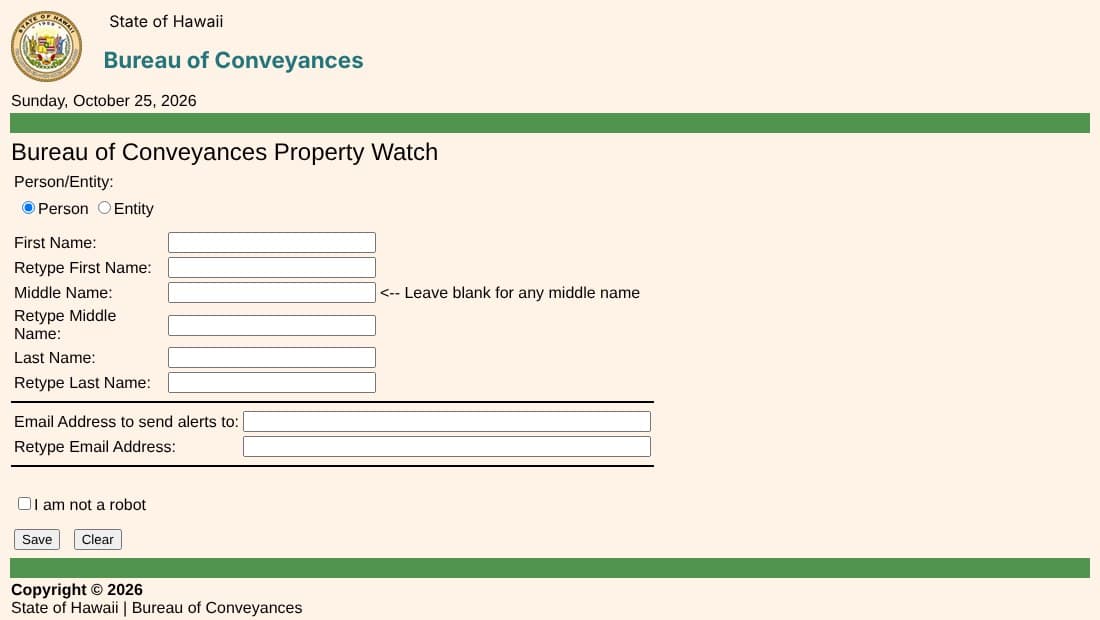
The Bureau launched Property Watch in January 2025, the Honolulu Star-Advertiser's Kokua Line column reported12. When a name you enter shows up as a party in a newly recorded document, you get an email13. It is Hawaii's version of the free alerts on our state-by-state map of county property fraud alerts.
To sign up, open the Property Watch form, pick Person or Entity, and type the name and your email, each twice14. Each co-owner can sign up, and a trust or company that holds your home can be added as an Entity12,14.
Know its limits before you count on it:
- Spelling decides everything. If the record says "John Smth," a watch on "John Smith" sends nothing. A common name can also bring emails about strangers13.
- It can't watch your parcel. Recorded papers "are not indexed via addresses or TMKs," the Bureau told Kokua Line12.
- It reports, it doesn't stop. The email comes after a paper is on record. The Bureau says the system "will not prevent fraudulent recordings from occurring"13.
What happened in Oahu's deed forgery cases?
Prosecutors say two men forged deeds to Oahu homes and land, recorded them at the Bureau, and sold or tried to sell what they did not own. Both pleaded not guilty and are charged, not convicted.
On November 13, 2025, the Attorney General announced that an Oahu grand jury had indicted, or formally charged, two men, ages 41 and 303. Both pleaded not guilty on November 17, and we found no verdict reported as of October 25, 202617. "The charges are only allegations," the Attorney General's office stresses3.
How common is this? Hawaii News Now counted at least eight Oahu properties, and possibly 15, with titles apparently stolen from 2022 to 202520. That is a small number next to 278,000 recordings in one year.
The men allegedly picked vacant properties and homes held in trust for absent owners. In Aiea, a realtor grew suspicious, found the real owner and heard: "I'm alive and well"17.
Lawmakers answered in 2026 with bills that would have the Bureau void deeds a notary says were faked and let owners pause new recordings (HB 1639 and SB 2782). Neither passed21.
What if a forged deed is recorded on your home?
A forged deed does not hand anyone your home, but only a court can clear it from the record. Report it, then get a lawyer.
Hawaii's Attorney General told lawmakers that "Hawaii courts have long held that forged deeds are void and do not pass title"4. Still, the Bureau says a recorded paper "cannot be removed from the public record" without a court order1.
- Get the document. Find it on RecordEASE and buy a copy; a certified copy takes 7 to 10 business days1.
- Report it to the Attorney General. The Bureau's "Report Deed Fraud" link goes to the Special Investigation and Prosecution Division's tip form. You can also call (808) 586-1266, or 911 in an emergency22,23.
- File a police report. Call the Honolulu Police Department at (808) 529-3111 and keep the report number24. In the Waialua case, that report reached the Attorney General19.
- See a lawyer about court. For Regular System land, the usual route is a quiet title action, a lawsuit asking a judge to settle who owns it25. For Land Court land, an owner can petition the court, which can order a new certificate or cancel an entry6.
- Ask about free help. The Legal Aid Society of Hawaii gives free civil legal help to low-income residents at 808-536-4302. The Hawaii State Bar Association can point you to a lawyer26,22.
Move fast with Land Court land. The law that lets a court fix a certificate also shields "a purchaser holding a certificate for value and in good faith"6. Our guide to a fraudulent deed on your home covers the general steps in more depth.
Court takes time and money. Hawaii's consumer protection office told lawmakers that even an owner who wins back title "will never be made whole financially"4.
If a forged document is recorded against a protected home, we work the case and pay the lawyers and court fees to get it cancelled. That is our Restoration Promise: up to $1M in restoration costs.
Not insurance. Not available in NY or Iowa. Terms apply.
Phone numbers, fees, hours and sign-up links in this guide were checked on the official pages on October 25, 2026.
Frequently asked questions
What is the Bureau of Conveyances in Hawaii?
It is the State of Hawaii office, part of the Department of Land and Natural Resources, that records deeds and other land papers for the whole state. It also issues Land Court certificates of title.
How much does it cost to record a document with the Bureau of Conveyances in Hawaii?
Up to 50 pages costs $41 in the Regular System and $36 in Land Court, plus $50 for a new Land Court certificate of title. A quitclaim deed, which passes whatever share the signer holds with no promise about the title, usually also needs a P64-A or P64-B conveyance tax form.
How do I get the deed to my house in Hawaii?
Find it on the Bureau's RecordEASE site with a free account and download it for $1 a page plus fees. For deeds recorded before 1976, mail a written request ($35 each plus a $10 fee) or search in person in the Bureau's Public Reference Room.
What does Land Court mean in Hawaii?
It is the State's land registration system, set up by a 1903 law. The State certifies who owns registered land on a certificate of title, and owners have been able to ask to leave it since 2009.
How can I search for a property in Honolulu by name?
The City's property search looks up parcels by address or TMK, not by owner name. To search by name, use the Bureau's RecordEASE site, which finds recorded papers by grantor or grantee name once you make a free account.
What date is local property tax due?
On Oahu, the first half is due August 20 and the second half February 20, or the next business day if the date falls on a weekend or holiday. Bills go out July 20 and January 20.
Two quick checks for this week
Look up your parcel's Sales Information to see which system holds your home. Then sign up for Property Watch under every owner's exact name, and add a trust or company name if one holds the title.
Open the Property Watch formSee what a recorded notice addsSources
- FAQs, Bureau of Conveyances, checked October 25, 2026
- Bureau of Conveyances, State of Hawaii Department of Land and Natural Resources, checked October 25, 2026
- Department of the Attorney General secures indictments for real property scam (News Release 2025-94), Hawaii Department of the Attorney General, November 13, 2025
- Testimony on HB 1639, Relating to Notaries Public (Department of the Attorney General, Department of Land and Natural Resources, DCCA Office of Consumer Protection), House Committee on Water and Land, February 3, 2026
- Real Property Assessment Division (home page and public alert on fake "House Auction" notices), City and County of Honolulu, checked October 25, 2026
- HRS §501-196, Alterations upon registration book prohibited when; court hearings; limitations, Hawaii State Legislature, checked October 25, 2026
- Procedures for timeshare deregistration from Land Court and voluntary deregistration, Bureau of Conveyances, September 10, 2021
- SB 2041 (2026): working group to recommend reforms to eliminate the Land Court, Hawaii State Legislature, status checked October 25, 2026
- Property Records Search (qPublic), City and County of Honolulu Real Property Assessment Division, checked October 25, 2026
- RecordEASE Web Access (document search sign-in page), Bureau of Conveyances, checked October 25, 2026
- General Public, Bureau of Conveyances, checked October 25, 2026
- Kokua Line: Will state alert us if our property title is changed?, Honolulu Star-Advertiser via Yahoo News, July 15, 2025
- Property Watch, Bureau of Conveyances, checked October 25, 2026
- Bureau of Conveyances Property Watch (sign-up form), checked October 25, 2026
- Maui homeowners urged to exercise caution, report unsolicited offers to buy their properties, Office of the Governor, August 15, 2023
- Hawaii AG: Real estate opportunists are preying on Maui fire victims, Hawaii News Now, September 3, 2023
- Serious red flags: Realtor's suspicions upended title theft scheme, Hawaii News Now, November 17, 2025
- Family of disabled woman loses thousands in forged deed scam, Hawaii News Now, November 25, 2025
- Oahu family faced fraudulent eviction in deed forgery scheme, Hawaii News Now, January 2, 2026
- Authorities address gaps that allowed deed forgery and title theft, Hawaii News Now, November 26, 2025
- HB 1639 (2026) and SB 2782 (2026) status pages, Hawaii State Legislature, checked October 25, 2026
- Contact us, Bureau of Conveyances, checked October 25, 2026
- Special Investigation and Prosecution Division, Hawaii Department of the Attorney General, checked October 25, 2026
- Honolulu Police Department, home page, checked October 25, 2026
- HRS §669-1, Object of action (quiet title), Hawaii State Legislature, checked October 25, 2026
- Legal Aid Society of Hawaii, home page, checked October 25, 2026
- Treasury Division, City and County of Honolulu Department of Budget and Fiscal Services, checked October 25, 2026